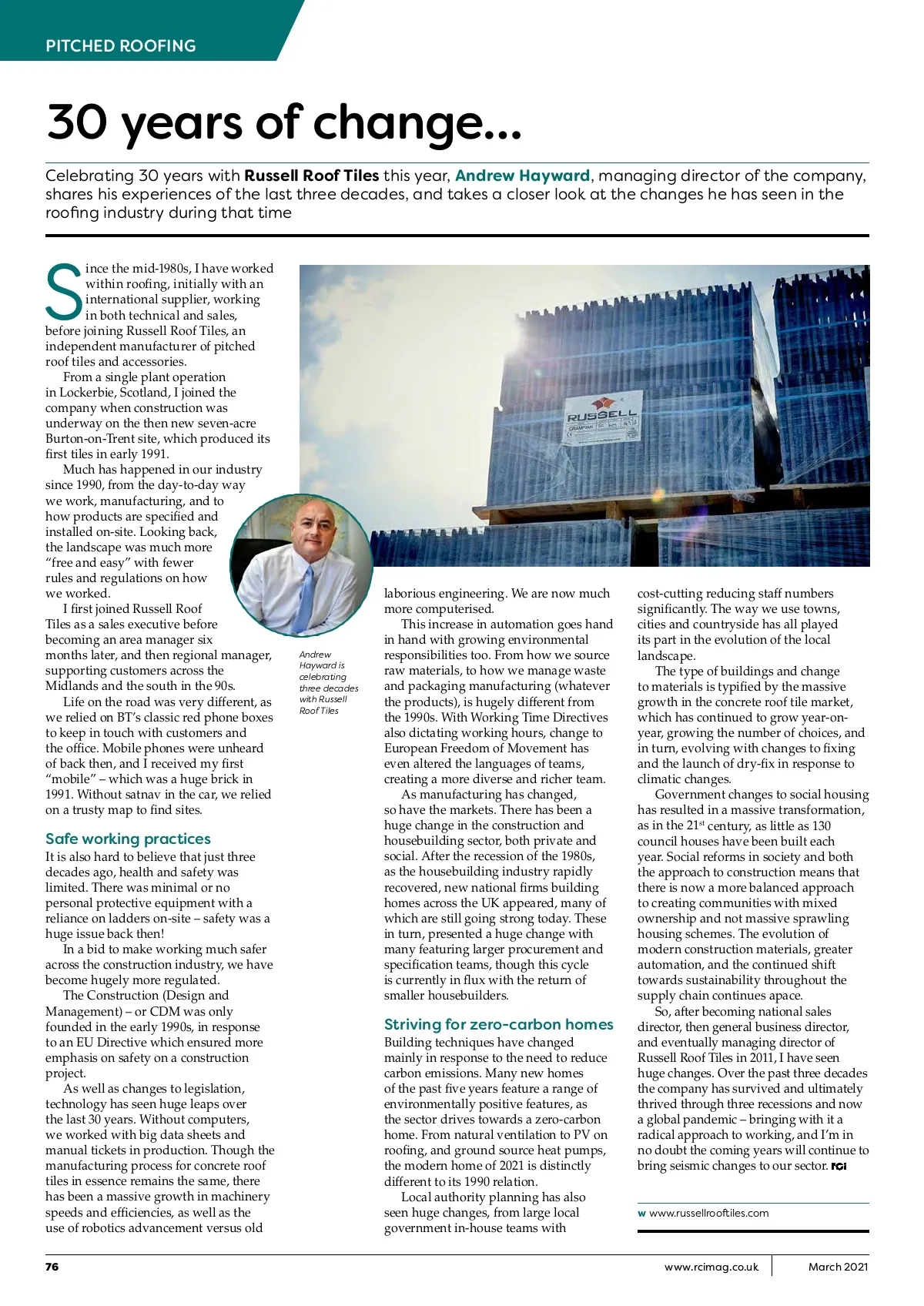
PITCHED ROOFING 30 years of change… Celebrating 30 years with Russell Roof Tiles this year, Andrew Hayward , managing director of the company, shares his experiences of the last three decades, and takes a closer look at the changes he has seen in the roofing industry during that time S ince the mid-1980s, I have worked within roofing, initially with an international supplier, working in both technical and sales, before joining Russell Roof Tiles, an independent manufacturer of pitched roof tiles and accessories. From a single plant operation in Lockerbie, Scotland, I joined the company when construction was underway on the then new seven-acre Burton-on-Trent site, which produced its first tiles in early 1991. Much has happened in our industry since 1990, from the day-to-day way we work, manufacturing, and to how products are specified and installed on-site. Looking back, the landscape was much more “free and easy” with fewer rules and regulations on how we worked. I first joined Russell Roof Tiles as a sales executive before becoming an area manager six months later, and then regional manager, supporting customers across the Midlands and the south in the 90s. Life on the road was very different, as we relied on BT’s classic red phone boxes to keep in touch with customers and the office. Mobile phones were unheard of back then, and I received my first “mobile” – which was a huge brick in 1991. Without satnav in the car, we relied on a trusty map to find sites. Andrew Hayward is celebrating three decades with Russell Roof Tiles Safe working practices It is also hard to believe that just three decades ago, health and safety was limited. There was minimal or no personal protective equipment with a reliance on ladders on-site – safety was a huge issue back then! In a bid to make working much safer across the construction industry, we have become hugely more regulated. The Construction (Design and Management) – or CDM was only founded in the early 1990s, in response to an EU Directive which ensured more emphasis on safety on a construction project. As well as changes to legislation, technology has seen huge leaps over the last 30 years. Without computers, we worked with big data sheets and manual tickets in production. Though the manufacturing process for concrete roof tiles in essence remains the same, there has been a massive growth in machinery speeds and efficiencies, as well as the use of robotics advancement versus old 76 laborious engineering. We are now much more computerised. This increase in automation goes hand in hand with growing environmental responsibilities too. From how we source raw materials, to how we manage waste and packaging manufacturing (whatever the products), is hugely different from the 1990s. With Working Time Directives also dictating working hours, change to European Freedom of Movement has even altered the languages of teams, creating a more diverse and richer team. As manufacturing has changed, so have the markets. There has been a huge change in the construction and housebuilding sector, both private and social. After the recession of the 1980s, as the housebuilding industry rapidly recovered, new national firms building homes across the UK appeared, many of which are still going strong today. These in turn, presented a huge change with many featuring larger procurement and specification teams, though this cycle is currently in flux with the return of smaller housebuilders. Striving for zero-carbon homes Building techniques have changed mainly in response to the need to reduce carbon emissions. Many new homes of the past five years feature a range of environmentally positive features, as the sector drives towards a zero-carbon home. From natural ventilation to PV on roofing, and ground source heat pumps, the modern home of 2021 is distinctly different to its 1990 relation. Local authority planning has also seen huge changes, from large local government in-house teams with cost-cutting reducing staff numbers significantly. The way we use towns, cities and countryside has all played its part in the evolution of the local landscape. The type of buildings and change to materials is typified by the massive growth in the concrete roof tile market, which has continued to grow year-on-year, growing the number of choices, and in turn, evolving with changes to fixing and the launch of dry-fix in response to climatic changes. Government changes to social housing has resulted in a massive transformation, as in the 21 st century, as little as 130 council houses have been built each year. Social reforms in society and both the approach to construction means that there is now a more balanced approach to creating communities with mixed ownership and not massive sprawling housing schemes. The evolution of modern construction materials, greater automation, and the continued shift towards sustainability throughout the supply chain continues apace. So, after becoming national sales director, then general business director, and eventually managing director of Russell Roof Tiles in 2011, I have seen huge changes. Over the past three decades the company has survived and ultimately thrived through three recessions and now a global pandemic – bringing with it a radical approach to working, and I’m in no doubt the coming years will continue to bring seismic changes to our sector. w www.russellrooftiles.com www.rcimag.co.uk March 2021
Roofing Cladding & Insulation March 2021: Page 76